Please Enter Your Details
Thank you! Your submission has been received!
Oops! Something went wrong while submitting the form.



.webp)
Cloudmon Network Assurance ensures real-time, reliable emergency communications by detecting network issues early and maintaining low-latency, uninterrupted connectivity when every second counts.

Background
Emergency response systems in modern cities depend on uninterrupted network connectivity. From 999 call routing to dispatch centers, ambulance GPS tracking, and real-time video feeds for first responders, every component runs over the city’s communication backbone. Even short-lived disruptions in network quality can delay response times, reduce situational awareness, and put lives at risk. Government emergencies require guaranteed reliability, low latency, and fast fault isolation.
Problem Statement
Government emergency services depend on real-time communication between control centers and field units. Yet, traditional monitoring tools only confirm whether devices and servers are powered on and reachable. They often miss the deeper issues that impact performance and safety.
For example:
⬩ Ambulance dispatch instructions may be delayed due to network congestion or misconfigured routing.
⬩ Inter-agency coordination systems can experience slowdowns, delaying police, fire, and medical response during emergencies.
The risk isn’t whether systems are “online” but whether the network is delivering data reliably and in real time. Undetected, these problems can lead to slower response times, public safety risks, reduced trust in government services.
How It Works
⬩ Active Path Monitoring:
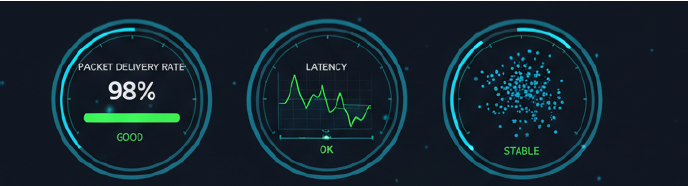
Assurance continuously measures packet delivery, latency ,and jitter between dispatch centers and ambulance IoT devices.
It goes beyond simple “ping” or device online checks ,measuring critical parameters such as:
⬩ Packet delivery rates to ensure commands and GPS updates reach their destination.
⬩ Latency, so dispatch instructions arrive within the expected timeframe.
⬩ Jitter, detecting variability in delivery times that can disrupt real-time tracking.
⬩ Early Detection:
Assurance detects that while devices and servers are reachable, packet loss spikes during peak traffic windows.
Solution Benefits
Public Safety & Trust
⬩ Guarantees ambulances receive dispatch orders without delay.
⬩ Strengthens citizen trust in government emergency services
Operational Efficiency
⬩ Isolates network-level issues before they cascade into service failures.
⬩ Reduces false escalations to application teams by proving it’s a network path issue.
⬩ Ensures emergency fleets operate at maximum efficiency
Government Continuity
⬩ Protects emergency services from disruption.
⬩ Provides audit-ready logs to demonstrate SLA compliance.
⬩ Ensures coordination across fire, police, and medical teams.
Financial & Risk Protection
⬩ Reduces liability from delayed emergency response.
⬩ Prevents costs associated with loss of life, lawsuits, or regulatory penalties.
⬩ Optimizes resource allocation by ensuring network reliability.
Operational Continuity
⬩ Avoid service interruptions in critical government operations(emergency services, public transport, healthcare networks).
⬩ Reduced downtime translates directly into maintaining essential public services without disruption.
Cost Avoidance
⬩ Prevent costly outages: downtime in government systems can cost millions, especially during peak operations or emergencies.
⬩ Reduce the need for expensive post-incident troubleshooting or emergency patches.
Faster Incident Response
⬩ Real-time monitoring allows IT teams to detect and respond to anomalies before they escalate.
⬩ Improves decision-making speed during emergencies (e.g., natural disasters,
public safety incidents).
Improved Service Delivery
⬩ Citizens experience more reliable online government services (portals, e payments, e-health).
⬩ Enhances public trust and satisfaction, hard to quantify, but critical for ROI in a government context.
Risk Mitigation
⬩Early detection of network issues reduces exposure to cyberattacks or system failures.
⬩ Protects sensitive data across government departments.
Resource Optimization
⬩ IT staff can focus on strategic projects instead of firefighting network issues.
⬩ Reduces overtime and operational inefficiency costs.
Long-term Infrastructure Savings
⬩ Identifies weak points in the network, preventing repeated failures and expensive hardware replacements.
⬩ Supports smarter investment in network upgrades or expansions.
Data-Driven Planning
⬩ Provides analytics on network usage, performance, and trends.
⬩ Helps in future-proofing government IT infrastructure efficiently.
Enhanced Public Safety
⬩ Reliable network assurance ensures uninterrupted communications for
⬩ emergency services, dispatch centers, and public safety networks.
⬩ The ROI here is measured in lives protected and risk reduction, not just money.
Regulatory Compliance
⬩ Helps meet government standards for uptime, data security, and reporting requirements.
⬩ Avoids penalties or reputational damage from non-compliance.


Hey, I’m Cloudmon’s AI assistant. Cloudmon unifies visibility across IT, OT, and IoT to reduce IT OPEX and strengthen security from a single platform.
How can I help you today?
🗓️ Book a demo
Introduce yourself to begin chatting with the AI assistant



.svg)