


The 2026 Observability ROI Guide
The 2026 Guide to Observability ROI: Maximizing Value with Unified Insight!



The 2026 Observability ROI Guide
Executive Summary
As we navigate 2026, the complexity of digital ecosystems has reached an inflection point. The rapid integration of Agentic AI, hybrid-cloud architectures, and distributed microservices has made traditional, fragmented monitoring not just inefficient, but a financial liability. For modern enterprises, the question is no longer "What is happening?" but "What is the cost of not knowing why?".
This white paper explores the shifting landscape of Observability ROI and demonstrates how the Cloudmon Unified Observability Platform serves as the definitive solution for consolidating tool sprawl, reducing Mean Time to Resolution (MTTR), and transforming telemetry into a strategic business asset.
1. The 2026 Observability Landscape: Complexity Meets Cost
In 2026, observability has moved from a technical "nice-to-have" to a boardroom priority. Two major trends define this era:
- The Proliferation of "Unknown-Unknowns": Modern AI-driven systems exhibit non-deterministic behaviors that traditional threshold-based alerts cannot catch.
- The Cost Crisis: Gartner reports that 36% of enterprises now spend over $1 million annually on observability, with over 50% of that cost often wasted on redundant logs and uncoordinated toolsets.
The Fragmented Tooling Tax
Most organizations still struggle with "tool sprawl," maintaining separate platforms for network, infrastructure, and application performance. This fragmentation leads to
- High TCO: Paying multiple licensing fees and maintaining diverse expertise for each tool.
- Context Switching: Engineers waste 40% of their time "swivel-chairing" between dashboards during an outage.
- Data Silos: Lack of correlation between network health and user experience.
2. Calculating ROI: Beyond the Technical Metrics
To accurately measure the ROI of an observability transition, leadership must look at three distinct buckets: Direct Cost Savings, Operational Efficiency, and Business Resilience.
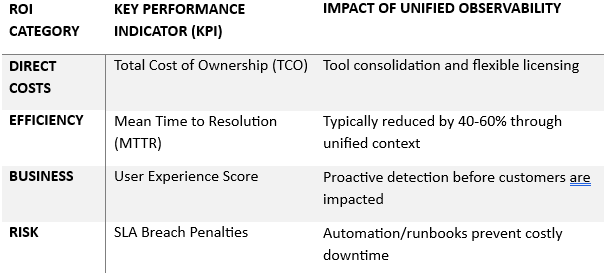
3. Cloudmon: The Strategic Driver for Unified ROI
Cloudmon is designed specifically to solve the fragmentation problem of 2026. By unifying Infrastructure, Network, and Digital Experience Monitoring (DEM) into a single pane of glass, Cloudmon changes the ROI equation.
A. Ending Tool Sprawl
Cloudmon replaces the need for separate NMS, APM, and DEM tools. Its agent-less and lightweight agent-based telemetry allows for 100% visibility without the "performance tax" of traditional instrumentation.
B. Drastic MTTR Reduction with "Intelli-Alerts"
Cloudmon’s Intelli-Alerts and rich context drill-downs eliminate alert noise. When an issue occurs, Cloudmon doesn't just say what is down; it shows the hop-by-hop network path and the specific server bottleneck, allowing for immediate remediation.
C. Automated Remediation (The Force Multiplier)
The highest ROI in 2026 comes from Autonomous Operations. Cloudmon’s integrated Runbooks allow IT teams to automate responses to known issues. Every incident resolved by a Cloudmon auto-remediation script represents $0 in labor cost and near-zero downtime, providing a direct boost to the bottom line.
Case Study: Global FinTech Transformation
From "War Room" Chaos to Autonomous Resolution
- The Client: A Tier-1 Global Financial Services provider managing over 5 million daily transactions across a hybrid-cloud environment (AWS, Azure, and On-Premise Legacy Core Banking).
- The Challenge (The "Visibility Gap"): Prior to 2026, the client utilized a fragmented monitoring stack consisting of four separate vendors for Network (NMS),Application (APM), Infrastructure, and End-User Experience.
- The Problem: A 15-minute outage in their payment gateway cost the firm approximately$2.2M in lost revenue and regulatory fines.
- The Bottleneck: Teams blamed each other—Network blamed Cloud; Cloud blamed Database. Root cause analysis (RCA) took an average of 9 hours across three separate time zones.
- The Solution: The client replaced legacy siloed tools with the Cloudmon Unified Observability Platform, integrating telemetry into a single correlation engine.
The Results
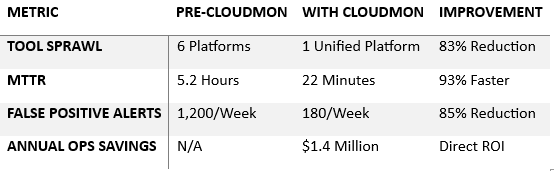
4. Implementation Strategy: The Path to Value
Maximizing ROI requires a phased approach to ensure the platform scales with the business:
- Baseline & Consolidate: Audit existing tools and migrate critical services to the Cloudmon platform to realize immediate TCO savings.
- Shift Left with DEM: Use Cloudmon’s Digital Experience Monitoring to track remote user performance, ensuring productivity remains high in a hybrid work world.
- Automate: Identify the top 20% of recurring alerts and deploy Cloudmon Runbooks to handle them automatically.
Conclusion
In 2026, observability is the "nervous system" of the enterprise. Organizations that continue to rely on fragmented, reactive monitoring will see their margins eroded by complexity and downtime. Cloudmonprovides the unified visibility, intelligent automation, and flexible scaling necessary to turn observability from a cost center into a competitive advantage. By consolidating your stack, you don't just see more, you spend less and resolve faster.



.svg)






Welcome to Cloudmon AI Assistant!
Hey, I’m Cloudmon’s AI assistant. Cloudmon unifies visibility across IT, OT, and IoT to reduce IT OPEX and strengthen security from a single platform.
How can I help you today?
🗓️ Book a demo
Introduce yourself to begin chatting with the AI assistant
